
Luana’s Kingdom
(A legend from Buzău, Romania)
“Long, long ago in these parts there was a king called Luana. Some said he was an enchanter, others a god, others that he belonged to the mighty brethren of the Enți who were masters of ceremonies. Luana had devised a sun that burned bright above the city walls, guarding the immortals who dwelt in that land. Thus they lived blissfully and in peace for many years. But their peace was not unending. Other tribes had in the meantime heard the news of Luana’s kingdom and became filled with great envy, and in the battle that followed, the Sun of Luana was struck down. The earth shook from its foundations, and the city was no more. The sky was alight with many chariots of fire raining destruction on the land. For an age afterwards, nothing grew there anymore, and no man nor any beast dared to make their way across the desolation left by the battle. Many a hapless traveller on Luana’s old road would vanish into thin air, never to be seen again by the living; only a few returned, and told strange tales of a grey world where they had wandered for a time as if through a mist. These travellers learned they needed a guide to take them to the wellspring of everlasting life. The knowledge of the ancients was lost to the depths of time, for Luana alone had known the secret of the Water of Life. Mortals continued to search for the wellspring on their own, but the Water would always turn to poison for them. Yet there is hope left, for it is told that one day, the children’s children of those who received the secret will return and guide all those who wander on the old paths. Of these things we are told in the markings from the cave of the wise hermit.”
Translated 2012 – original article Traces of Prehistoric Cosmic War Found in Cave, 1985
Gallery: local artworks and scenography for TV (’60s through to early ’90s)
LORELAI: Hey, love, guys. Love, okay? Lord of the Rings is all about the love.
BOY: Nuh uh, it’s about the destruction of all mankind.
LORELAI: And who doesn’t love that?
GIRL: Riley said only boy hobbits can travel to Mount Doom. Is that true?
(Gilmore Girls S4E03, 2003)
Through the main literary references runs the implication that the travel to Mount Doom was in fact a historical ritual undertaken throughout time by various knights, brotherhoods, religious orders, etc. The most recent non-literary reference is from the first half of the 1600s, with hermits taking up residence in the stone caves around Buzău. While there is no direct mention of the travellers having to be male, what seems true is that they were all a certain kind of outsider, looking for the Sun.
Inspired by Middle-Earth
(Books by J.R.R. Tolkien)
Gallery: Memories Asunder, 2004


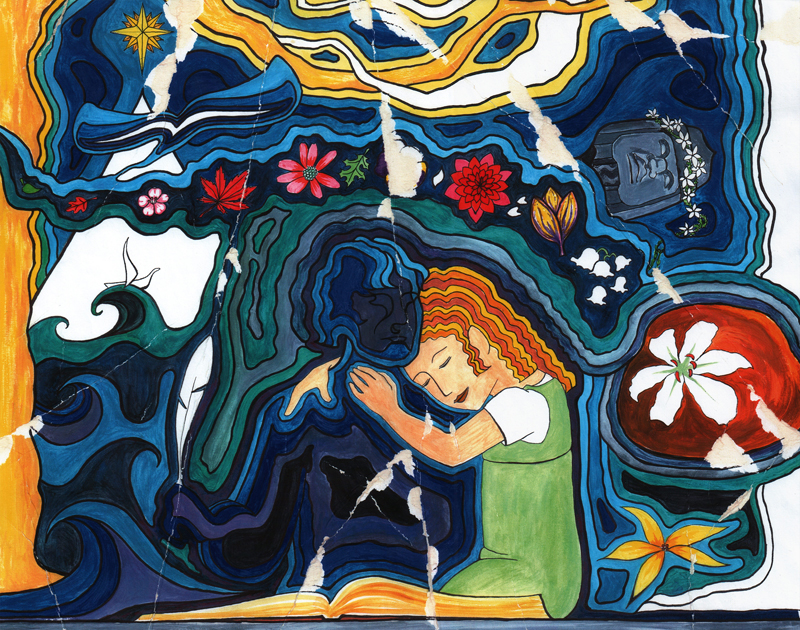
The Sea/2006. “Elanor was silent for some time before she spoke again. ‘I did not understand at first what Celeborn meant when he said goodbye to the King. But I think I do now. He knew that Lady Arwen would stay, but that Galadriel would leave him. I think it was very sad for him. And for you, dear Sam-dad. For your treasure went too. I’m glad Frodo of the Ring saw me, but I wish I could remember seeing him.’ “ (J.R.R. Tolkien, unpublished epilogue to The Lord of the Rings)
The Tongariro Crossing, New Zealand
(Film location of “The plains of Gorgoroth” and “Mount Doom”)
Got lost in thick fog while hiking with a friend from the Czech Republic (2006). Started getting dreams about Elfland. Dismissed an uncanny blog post that linked the Black Land with the legend of Zamolxis: “The Lord of the Rings lived in Romania !!! !!!!” (lots of exclamation marks) scared the crap out of me at first, but it also helped me factor in that there had been an actual person living somewhere “that was his home” (as Tolkien put it) and so the loss of this history started to feel more like suppression. I had been suspecting as much, though not exactly why… Anyhow, there is no other explanation for why those involved in the conflict feared the incarnate version so much: it held the living story, the truth that cannot be suppressed because everyone can see it. This means that in the meantime, those who could still visualise what he looked like “in fair form” truly had some special abilities, didn’t they? 😀
Gallery: Dreams in Faerie, 2006
Religious Beliefs of the Thracians
(From a travel in Bulgaria)
“Thracian religion belongs to Thracian Orphism and to the spiritual achievements of the Thracian and Pelasgian ethnic and cultural community. It is a synthesis resulting from giving a new meaning to and revising the concepts from the Eastern Mediterranean traditions, at least from the end of the 2nd Millennium B.C. The most prominent figures in the Thracian pantheon are those of the Great Mother Goddess and her son – the Sun – from whose marriage the ruling Hero was born.
The idea of the Great Goddess as a stone cave or womb is found in Southwest Asia, where Hellenic historical sources sometimes call her Kybele. The goddess is unnamed, but her essence is that of Megale Thea (the Great Goddess) and her names vary by region: Bendida, Kotito, Zerinthia, Brauro, etc. Hellenic authors emphasise her aspects, calling her Artemis, Artemis the Queen, Rhea, Hekate, etc.
The combination of the solar and terrestrial principles whose balance is realised by the Sun-husband of the Mother Goddess is the basis of Thracian religion. The supreme Thracian god preserves the uranic-solar characteristics of the Indo-European god of thunder but, at the same time, is a cosmogonic chthonic god identified with stone. In the context of the solar cult in Egypt and in the Indo-Iranian cultural cycle of the 2nd Millennium B.C., probably also in Thrace, the worship of the Sun precedes chthonism. The terrestrial god was accepted first in Delphi in the 8th Century B.C. He is unnamed but may be identified also by one of his literary names — Zagreus.
In Hellenic tradition, the two principles are personified as Orpheus (Apollo) and Dionysus, who also reflect the two manners of professing the cult — enthusiastic and ecstatic. In Northeastern Thracian regions, Zamolxis-Gebeleizis is the figure that unites the uranic-solar and chthonic characteristics.”
Text from exhibit inside Thracian mound at Pomorie (formerly Anchialos), Oct. 2023
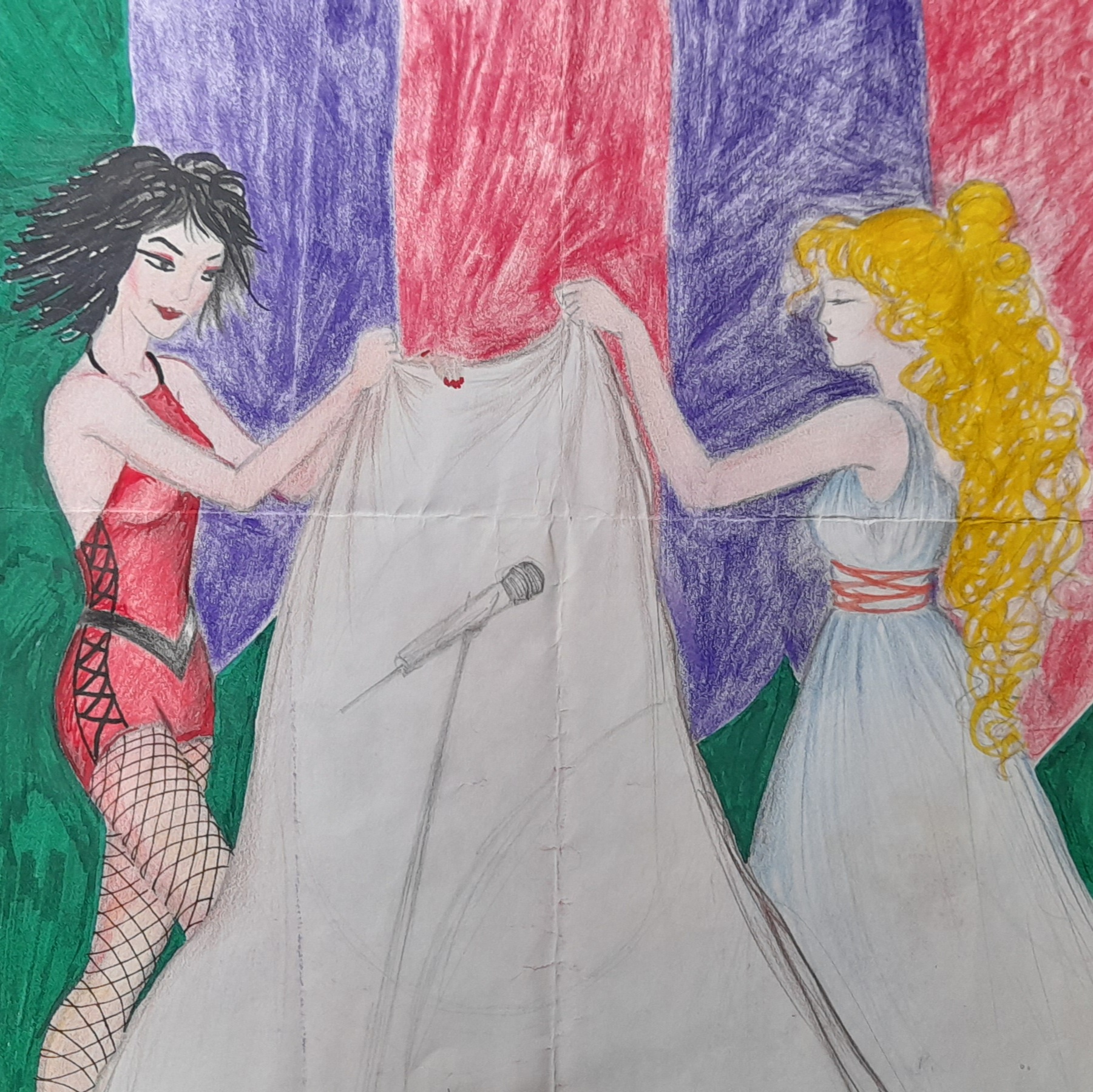
Queen Music – An Orphic Ceremony/2001. Something I saw in my mind once when feeling bored in class – I kept thinking our Literary Studies teacher was getting the Apollonian and Dionysian principles all wrong. I was so upset, in fact, that I wrote a long letter to my classmate (I wish I still had that letter).
Childe Roland to the Dark Tower Came
(William Shakespeare, Robert Browning, John Ashbery and Stephen King – join The Band!)
“I was conscious of no allegorical intention of writing it … Childe Roland came upon me as a kind of dream. I had to write it then and there, and I finished it the same day, I believe. I do not know what I meant beyond that, and I do not know now. But I am very fond of it.” (R. Browning)
Roland had always been dismissed as a member of “The Band” – a group of knights searching for the Dark Tower, all of whom had failed in their quest. Despite that, all Roland wants is to join The Band, whatever the cost. As soon as he steps into the path towards the Dark Tower, the landscape around him shifts, and Roland finds himself completely alone in a featureless wasteland. He reaches a river which he fords with trepidation, half-convinced that he is stepping on dead bodies floating under the water. Reaching the other bank, Roland is disturbed once more by the apocalyptic landscape, envisioning some dreadful battle that must have happened to create the scene of devastation he observes. Eventually the plain gives way to mountains, and Roland finds himself stuck, unable to find a clear path forward. Suddenly, Roland realizes that the mountain he has been looking at is the very one that hides the Dark Tower. (Wikipedia)
John Ashbery’s poem The System from his book Three Poems (1972) muses on Childe Roland’s potential facial expressions, as well as the image of the knight’s approaching The Dark Tower, to stand for a state of “expectancy” created before confrontations of the sort anticipated with the “King of Elfland.” (Wikipedia)
Was this the facial expression referred to? 😀

Astrom in Her Secret World/2002
Legolas at Night – C.S. Lewis and the Dreams of the Elves
By Thomas Hillman, Nov. 2017
The other day I was listening to one of Malcolm Guite’s marvelous talks – I say marvelous, as if, absurdly, there were talks of his that were not marvelous – this one was on C.S. Lewis and part of a series on The Inklings. Right near the end, he read aloud Lewis’ poem, The Adam at Night, to convey Lewis’ sense of what the consciousness of an unfallen human being might be like. In this poem, first published in Punch in 1949, Lewis imagines Adam not sleeping, says Guite, but, ‘as it were, entering into the consciousness of the world itself without losing his consciousness as a person’:
Except at the making of Eve Adam slept
Not at all (as men now sleep) before the Fall;
Sin yet unborn, he was free from that dominion
04 Of the blind brother of death who occults the mind.
Instead, when stars and twilight had him to bed
And the dutiful owl, whirring over Eden, had hooted
A warning to the other beasts to be hushed till morning
08 And curbed their plays that the Man should be undisturbed,
He would lie, relaxed, enormous, under a sky
Starry as never since; he would set ajar
The door of his mind. Into him thoughts would pour
12 Other than day’s. He rejoined Earth, his mother.
He melted into her nature. Gradually he felt
As though through his own flesh the elusive growth,
The hardening and spreading of roots in the deep garden;
16 In his veins, the wells filling with silver rains,
And, thrusting down far under his rock-crust,
Finger-like, rays from the heavens that probed, bringing
To bloom the gold and diamond in his dark womb.
20 The seething, central fires moved with his breathing.
He guided his globe smoothly in the heaven, riding
At one with his planetary peers around the Sun;
Courteously he saluted the hard virtue of Mars
24 And Venus’ liquid glory as he spun between them.
Over Man and his mate the Hours like waters ran
Till darkness thinned in the east. The treble lark,
Carolling, awoke the common people of Paradise
28 To yawn and scratch, to bleat and whinny, in the dawn.
Collected now in themselves, human and erect,
Lord and Lady walked on the dabbled sward,
As if two trees should arise dreadfully gifted
32 With speech and motion. The Earth’s strength was in each.
The first three quatrains (lines 1-12) called at once to my mind Tolkien’s characterization of the dreams of Elves:
“With that [Aragorn] fell asleep. Legolas already lay motionless, his fair hands folded upon his breast, his eyes unclosed, blending living night and deep dream, as is the way with Elves.” (The Two Towers 3.ii.442)
Legolas can do the same thing, or something very like it, by day as well:
“… and he could sleep, if sleep it could be called by Men, resting his mind in the strange paths of elvish dreams, even as he walked open-eyed in the light of this world.” (The Two Towers 3.ii.429)
While quatrains 4 through 7 (12-28) do not bear the same close resemblance to what we find in Tolkien, the essential closeness of Adam to the world and the creatures in it is reminiscent of how closely to Arda the Elves are bound. Even at death they do not leave it — as do Men whose proper home is not in Arda, but somewhere beyond it — but after a time live again. And this will be so for as long as Arda lasts. In keeping with this is their way with nature, ranging from Legolas’ ability to hear the stones of Hollin and communicate with Arod, the horse loaned him by Éomer, to the Elves’ power to enchant and to ‘wake up’ creatures and teach them to talk, as they did with the Ents.
Even so, the reference to the ‘common people of Paradise’ in lines 27-28 seems far more Narnian, and it is hard not to think of Tor and Tinidril of Perelandra when Lewis calls Adam and Eve ‘Lord and Lady’ in line 30. Yet this also turns us back to Tolkien, since the names Tor and Tinidril are modelled on Tuor and Idril from The Silmarillion, and his Ents are very much trees ‘dreadfully gifted with speech and motion’. But so, too, in a sense, are Ask and Embla, the first two humans of Norse Mythology, whom Odin, Vili, and Vé fashioned from tree-trunks they found on the seashore: ‘[o]ne of Bor’s sons gives [them] spirit and life; the second, mind and movement; the third, appearance, speech, hearing, and vision’ (Lindow, 62). Both Lewis and Tolkien of course knew this myth perfectly well.
Finally in this lovely web of influences we should not forget that Tolkien modeled the way Treebeard spoke ‘on the booming voice of C.S. Lewis’ (Carpenter, 1977, 194), just as Lewis drew on Tolkien to shape his hero, Ransom, the philologist and hero of his Space Trilogy.
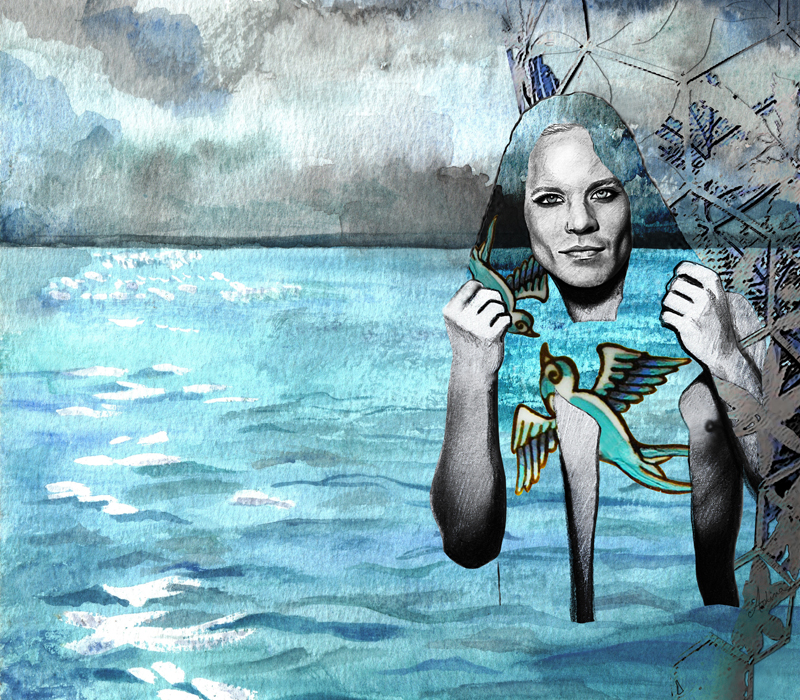
So The Journey Can Begin/2013
This Wandering Day
(David Donaldson, David Long, Janet Roddick, Steve Roche; lyrics by J.D. Payne)
The sun is fast fallin’ beneath trees of stone
The light in the tower, no longer my home
Past eyes of pale fire, black sand for my bed
I trade all I’ve known for the unknown ahead
Call to me, call to me lands far away
For I must now wander this wandering day
Away I must wander this wandering day
Of drink I have little, and food I have less
My strength tells me “No”, but the path demands “Yes”
My legs are so short and the way is so long
I’ve no rest nor comfort, no comfort but song
Sing to me, sing to me lands far away
Oh, rise up and guide me this wandering day
Please, promise to find me this wandering day
At last comes their answer through cold and through frost
That not all who wonder or wander are lost
No matter the sorrow, no matter the cost
That not all who wonder or wander are lost
Rime/2004. Story by Cara J. Loup from Germany, whose pen-name references “a longtime affinity with wolves.” Photo taken by me at the “Hobbiton” film location in Matamata, New Zealand.
My Fairy King
(Songwriters: Freddie Mercury)
In the land where horses born with eagle wings
And honey bees have lost their stings
There’s singing forever (oh yeah)
Lion’s den with fallow deer
And rivers made from wine so clear
Flow on and on forever
Dragons fly like sparrows thru’ the air
And baby lambs where Samson dares
To go on, on, on, on
My Fairy King can see things that are not there for you and me
(He rules the air and turns the tides)
My Fairy King can do right and nothing wrong
(He guides the winds)
Then came man to savage in the night
To run like thieves and to kill like knives
To take away the power from the magic hand
To bring about the ruin to the promised land
They turn the milk into sour, like the blue in the blood of my veins
(Why can’t you see it?)
Fire burnin’ in hell with the cry of screaming pain
(Son of Heaven, set me free and let me go)
Sea turns dry no salt from sand, seasons fly no helping hand
Teeth don’t shine like pearls for poor men’s eyes
Someone, someone
Has drained the colour from my wings
Broken my fairy circle ring
And shamed the king in all his pride
Changed the winds and wronged the tides
Oh Mother Mercury (Mercury)
Look what they’ve done to me
I cannot run, I cannot hide
– 1 9 7 3
 Adina Ispas